

In the field, there are times that researchers look forward to their whole careers. Dr. Alexis Levengood found hers while on a research boat off the coast of Hervey Bay, Queensland. A bottlenose dolphin broke the surface of the water with something very large in its mouth. She said her response was quick and not based on science: she started screaming.
An important thing that the University of the Sunshine Coast team was able to do was film a dolphin doing something scientists call “shelling.” It’s a way for dolphins to hunt. They chase fish into a big empty shell, bring the shell to the surface, and then shake it so the fish falls right into their mouth. It sounds almost too smart to be true. But it was caught on camera in the Great Sandy Marine Park.
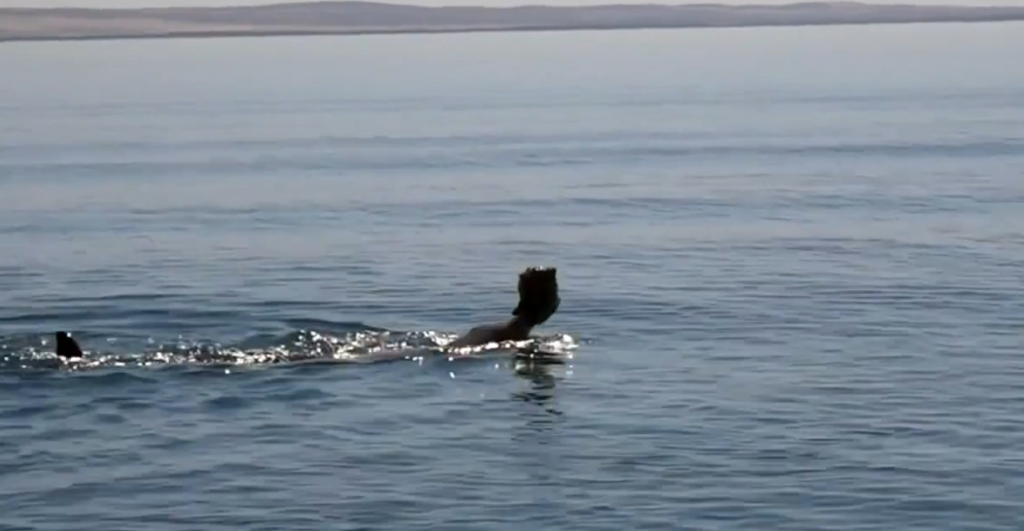
The video, taken from July to October 2025 and published in the journal Marine Mammal Science, is the first time that shelling on Australia’s east coast has been seen on film. Before this, the only known cases of this behavior were from Shark Bay in Western Australia, which is about 3,700 miles away. It’s interesting to think that two different groups of dolphins, living on opposite sides of the continent, came up with the same technique on their own. That being said, this behavior might be more common than anyone thought. It was just that scientists weren’t looking in the right places or at the right times.
It’s not just the hunting that makes the footage from Queensland so striking. Researchers saw a female dolphin come to the surface with a shell on her back, lose the fish inside, and then drop the shell to chase the fish. After a short time, her calf picked up the same shell and held it the same way its mother had. Researchers say that brief, almost silent moment could be the first sign of something they call “maternal social transmission.” This means that the dolphins may learn this behavior not from their peers or by trial and error, but by watching their mothers do it. It changes the picture a great deal. People used to think that dolphins shared their tool use horizontally, between members of the same group. This makes me think it might move up and down generations.
It’s important to note that shelling probably happened in the area a long time before scientists finally wrote it down. After the first observations for the study, researchers talked to local tour guides who showed them older pictures of dolphins using shells from as early as 2019. Six years of behavior that hasn’t been reported and hiding in plain sight. That gap shows that it’s easy to miss things in the ocean and that we still don’t know much about what’s going on below the surface. It doesn’t necessarily mean that people were careless.
Dolphins have always been a tricky part of our understanding of how animals think and reason. The common perception is that they are friendly, playful, and generally happy. On the other hand, the growing body of scientific evidence keeps showing a deeper truth. To use sponges in Shark Bay, work together to find food, and use signature whistles that work like names. The way each new discovery lands is a little different. It feels very direct to shelling. There is no doubt in the video. The dolphin knows it’s using a tool to get food. That isn’t instinct working by itself. That sounds more like a strategy.
Levengood is careful not to say too much about what has been proven. There are still questions about how common the behavior is, whether it is linked to certain environments or the availability of prey, and what makes a calf start playing with tools. She said, “There’s still a lot we don’t know,” which is an honest statement. Beautiful video, but it only shows two sightings and not a population study. It will take time and more fieldwork to fill in the bigger picture.
To this day, the sight of a calf picking up its mother’s broken shell and trying to figure out what to do with it is hard not to find extremely moving. The gap between how people act and how animals act feels a little less fixed during that moment of imitation. It was tentative, curious, and could have been the start of a learned skill.
| Detail | Information |
|---|---|
| Topic | Dolphins Shelling Behavior |
| Species | Bottlenose Dolphins (Tursiops sp.) |
| Location of Observation | Great Sandy Marine Park, Hervey Bay, Queensland, Australia |
| Footage Captured | July – October 2025 |
| Study Published In | Marine Mammal Science (journal) |
| Lead Researcher | Dr. Alexis Levengood, University of the Sunshine Coast (UniSC), Australia |
| What Is Shelling? | Dolphins chase fish into large empty shells, carry the shell to the surface, and shake it to drain fish into their mouths |
| Previous Documentation | Only at Shark Bay, Western Australia — no footage had been captured there |
| Distance Between Two Locations | Approximately 3,700 miles apart |
| New Finding: Maternal Transmission | A calf was observed picking up and holding a shell the same way its mother had, suggesting skill is passed from mother to offspring |
| Earliest Undocumented Evidence Found | Photographs from local tour guides showing shelling behavior as far back as 2019 |
| Significance | First filmed evidence of shelling on Australia’s east coast; first potential evidence of maternal social transmission of tool use in dolphins |
| Article Word Count | ~680 words |
