

Approximately 4.5 million square kilometers of the Pacific seafloor, built up over millions of years into one of the planet’s more geologically rich oceanic regions, lie peacefully and darkly between Hawaii and Mexico. Polymetallic nodules filled with cobalt, nickel, and manganese—the exact metals that battery manufacturers have been eyeing for years—are scattered throughout the Clarion-Clipperton Zone, or CCZ as researchers like to refer to it. The tuna also seem to be moving in that direction more and more.
According to a study published in npj Ocean Sustainability, commercially important tuna species like skipjack, yellowfin, and bigeye are being driven eastward as ocean temperatures rise and oxygen levels fall throughout the western Pacific. into the CCZ. The Metals Company, a Vancouver-based company that collaborated with the island nation of Nauru, has been pushing for the first industrial-scale mining license in the same zone where 17 deep-sea mining exploration contracts have already been awarded. There is no subtlety to the projections. By the middle of the century, bigeye, yellowfin, and skipjack populations are predicted to grow by approximately 10 to 11 percent, 23 percent, and 31 percent, respectively. Regardless of whether emissions are drastically reduced or allowed to spiral out of control, averaging that out will result in a 21 percent increase in tuna biomass throughout the zone.
For a moment, it’s difficult to ignore the particular ridiculousness of that overlap. Tuna is being pushed into the path of an industry that exists, in part, to supply materials for the transition to green energy by the same forces causing climate change. The cobalt and nickel used in electric car batteries are found in the nodules on the CCZ seafloor. The tuna is being relocated in the first place because of the warming those vehicles are supposed to mitigate. circular in a way that, if you don’t consider the ramifications too carefully, is almost elegant.
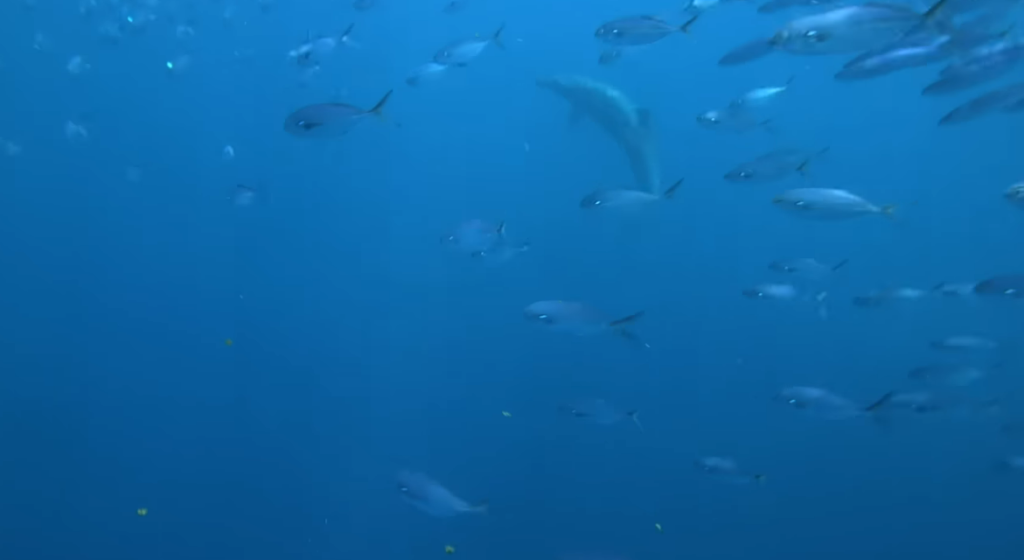
The repercussions are worth considering. Heavy machinery is dragged along the seafloor by mining operations, resulting in sediment plumes that can stretch hundreds of kilometers horizontally. When extracted material is drawn to the surface and waste water is released back into the mid-ocean column, a second plume is created. Although scientists are still unsure of the precise location in the water column where that discharge would land, there is cause for concern: particles could enter the food chain, clog gills, interfere with the prey that tuna rely on, and accumulate in tissue in ways that eventually reach human consumers. Another layer is added by noise pollution from heavy machinery operating continuously. Fish migration and feeding behavior are known to be affected by low-frequency sound. The issue is that none of this is yet completely understood.
There are significant and unequal financial stakes. Together, the tuna fisheries in and around the CCZ produce about $5.5 billion a year. Between 2009 and 2018, nations like Mexico and Venezuela collectively harvested about 250,000 tonnes of tuna from the wider Pacific, earning more than half a billion dollars during that time alone. Then there are the Pacific Island states, such as the Federated States of Micronesia, the Marshall Islands, and Kiribati, whose governments rely largely on fishing license fees. Tuna revenue moves eastward, away from their exclusive economic zones, and sometimes not in the direction of the nations that most need it. According to FAO modeling, catches may decrease by as much as 37% in Papua New Guinea and 26% in the Federated States of Micronesia by 2050, but they may increase further east, where tuna are predicted to congregate.
The fact that so much of this is happening in a regulatory vacuum is startling and a little unsettling. The regulations for commercial mining are still being developed by the International Seabed Authority, the UN agency in charge of overseeing high-seas mineral operations. A statement urging a moratorium has been signed by more than 700 ocean scientists. At the same time, Canada, whose own business is one of the main companies vying for mining contracts, has demanded a halt. The timelines continue to slip, the conversations continue, and the tuna are already in motion. The ocean is not waiting for a policy document to be finalized.
Observing all of this from a distance gives the impression that those making decisions regarding the CCZ are using maps that do not yet incorporate one another. Climate modelers, mining regulators, and fisheries managers all have a picture of the zone, but they haven’t been properly stacked on top of one another. In the words of UBC marine scientist Juliano Palacios Abrantes, who co-authored the study, “no one has actually studied the possible interconnections between deep-sea mining and these fisheries.” When the industry in question calculates its catch in millions of tonnes, that disparity doesn’t seem insignificant.⁖※
