

Moon jellyfish hover in a tall, neon-lit aquarium in a darkened lab at the University of Colorado Boulder. Their translucent, bell-shaped bodies expand and contract in a slow, rhythmic pulse. They appear to be nearly weightless. Nearly serene. When it comes to an invertebrate that hasn’t changed in over 500 million years, Nicole Xu watches them with what can only be called true affection. However, since she was a graduate student, Xu has been fascinated by the movement of moon jellyfish, and what she has developed around that fascination is one of the most surprising ocean research projects going on anywhere in the world right now.
The basic idea is to attach a tiny microelectronic device to a live moon jellyfish, use it to send electrical pulses to the swimming muscles of the animal, and direct the jellyfish toward parts of the ocean that are practically unreachable by any other means. According to Xu, the system functions similarly to a pacemaker on a heart, causing contractions, controlling movement, and directing the animal to follow researchers’ instructions. The gadget will eventually be equipped with sensors that can instantly record temperature, pH, and other environmental information. The Mariana Trench, which is located about 36,000 feet below the western Pacific’s surface, is the ultimate target. There, moon jellyfish have been discovered. Costly robotic submersibles are frequently unable to withstand the pressure. After half a billion years of doing this, the jellyfish appear to be doing just fine.
| Field | Details |
|---|---|
| Project Name | Biohybrid “Cyborg Jellyfish” for Deep-Ocean Exploration |
| Lead Researcher | Nicole Xu — Assistant Professor, Paul M. Rady Department of Mechanical Engineering, CU Boulder |
| Institution | University of Colorado Boulder (CU Boulder) |
| Species Used | Moon jellyfish (Aurelia aurita) |
| First Field Test | 2020 — shallow ocean waters off Woods Hole, Massachusetts |
| How It Works | Microelectronic device sends electrical signals to stimulate swimming muscles — functions like a cardiac pacemaker |
| Target Depth | Up to ~36,000 feet — including the Mariana Trench, western Pacific Ocean |
| Why Jellyfish? | Most energy-efficient swimmers on Earth; no brain, no spinal cord, no nociceptors (pain receptors); 500+ million year-old body structure unchanged |
| Data to Be Collected | Ocean temperature, pH levels, and other environmental characteristics |
| Latest Research | Study on biodegradable PIV tracer particles (corn starch, arrowroot starch) published in Physical Review Fluids, 2025 |
| Ethical Consideration | No increased mucus production observed; jellyfish reproducing normally in lab tanks |
| Broader Goal | Inspire next-generation energy-efficient autonomous underwater vehicles based on jellyfish propulsion |
| CU Boulder Research Funding | $742 million in 2023–24; ranked No. 5 U.S. university for startup creation |
| Key Collaborators | Graduate students Marshall Graybill, Charlie Fraga; research associate Yunxing Su; graduate student Mija Jovchevska |
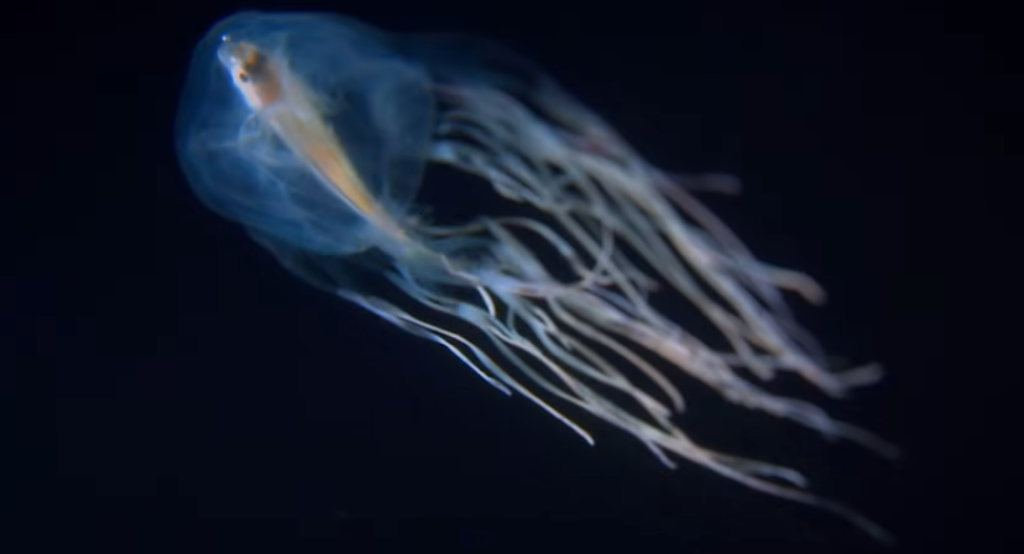
In 2020, Xu conducted the first practical test of the idea by guiding cyborg jellyfish through shallow ocean waters off the Massachusetts coast of Woods Hole. It was successful. In order to enhance control, add functionality, and make the system usable in the kinds of remote deep-ocean environments where the most crucial data is currently the most difficult to gather, a patient and methodical effort has been made to fully comprehend the mechanics of jellyfish movement. Moon jellyfish are by far the planet’s most energy-efficient swimmers. They lack nociceptors, which are sensory receptors that identify potentially dangerous stimuli, as well as a brain and spinal cord. They do possess simple overlapping nerve nets that react to the electrical signals produced by Xu’s apparatus. Additionally, they reproduce flawlessly in captivity. Xu’s lab tanks are lined with tiny polyps, which are pinhead-sized baby jellyfish that serve as a fairly direct indicator of the animals’ level of stress or lack thereof.
Xu takes the ethical aspect seriously, and it’s important to note that she does so on her own initiative rather than in reaction to criticism. It used to be widely believed that invertebrates were incapable of feeling pain. This year, Xu co-authored a paper highlighting the need for further research on the effects of research on invertebrates in particular, as that assumption has begun to fall apart. According to behavioral indicators that researchers can see, such as mucus production and reproduction rates, her jellyfish seem to be doing well. However, she does not consider that to be a definitive question.
What kind of particles should researchers suspend in water to track the flow patterns jellyfish create when they swim? This problem sounds almost comically banal until you realize why it matters, according to Xu’s lab’s most recent published work. Hollow glass spheres or coated synthetic beads are used in standard practice; these are efficient but costly, possibly dangerous, and indigestible by animals. The biodegradable substitutes corn starch, arrowroot starch, jojoba beads, baking powder, and walnut shell powder were tested in the lab using laser light to monitor water flow through a jellyfish tank. Corn starch and arrowroot starch performed as well as synthetic particles at a fraction of the price and with virtually no toxicity. It may seem like a small detail, but Xu’s ability to safely and affordably study flow patterns is what allows him to fine-tune the mechanics of jellyfish propulsion to the point where machines can eventually replicate it.
It’s difficult to ignore how this strategy differs from the direction that most ocean exploration technology has been taking, which is toward robotic systems that are bigger, more costly, and more capable. All of that has merit. However, a platform that uses biological energy, is small enough to fit in the palm of the hand, can naturally navigate under extreme pressure, and is far less expensive than a conventional autonomous underwater vehicle has some genuine utility. According to Xu, the jellyfish is more than just an instrument for studying the ocean. It serves as a model for the type of pressure-tolerant, energy-efficient underwater vehicles that scientists have been attempting to create from the ground up for years. That issue has already been resolved by the ocean. Her ability to read the solution is still developing.
