

Reading NOAA’s updates on North Atlantic right whales has a subtly depressing quality. They don’t read like reports on conservation. Each whale is given a number, sometimes a name, a last known location, and a list of injuries; they read like case files. The 5-year-old male whale #5192 was observed on June 8th with a fishing line trailing behind his flukes and sinking into the water column beneath him along the left side of his mouth. Two days later, researchers made another attempt to contact him in the vicinity of the Magdalen Islands. The weather was uncooperative. He’s still out there.
In actuality, the edge of extinction looks like this. Slow, recorded, and filed under ongoing cases rather than abrupt and dramatic. The North Atlantic right whale health updates provided by NOAA have evolved into something akin to a species’ medical chart; they are comprehensive, clinical, and progressively difficult to read without feeling uneasy.
Approximately 340 of these animals remain. Although that figure has been in circulation for some time, it is still difficult to comprehend. To put things in perspective, that is fewer people than the majority of small-town high school graduating classes. Each death has statistical significance. The math is further skewed in the wrong direction with each new entanglement. A 3-year-old female whale calf known to researchers as “Porcia” washed up on a barrier island off the eastern coast of Virginia in February. She was the 43rd confirmed death in what NOAA refers to as an Unusual Mortality Event, a term that started to feel understated by bureaucracy years ago.
Division came next. The 4-year-old male whale #5217 ended up serving as a sort of involuntary test case to see how far entanglement response teams can go before nature overcomes them. In December 2025, teams cut the line over the left side of his head and removed gear from his flipper to partially disentangle him from Georgia. In the hopes that the drag would aid in shedding the remaining rope, they reattached a telemetry buoy. It didn’t. Aerial surveys conducted off North Carolina in late January 2026 revealed a partially submerged carcass floating about 25 miles offshore, surrounded by sharks. It was him, according to scientists at the New England Aquarium. The body could not be recovered. That was a decision already made by the ocean.
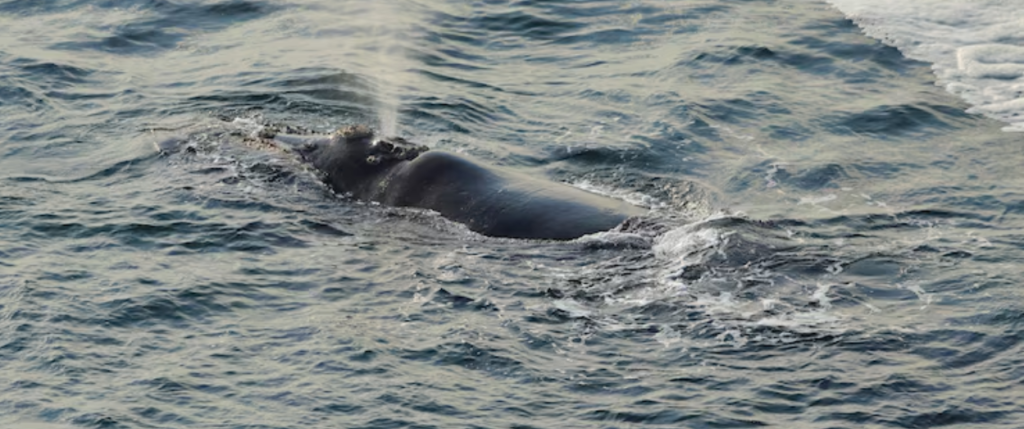
Observing the number of these cases, you are struck by how much work goes into recording a loss that continues to occur. The tracking tags measure dive depth, swim speed, ocean temperature, and even sound. Some are the size of a cell phone, while others are more akin to a paperback book. In 2022, a pregnant whale named Smoke was fitted with a suction cup tag that tracked her migration south toward calving grounds for 10.5 hours. Unexpectedly, the data showed that she remained silent the entire time. It turns out that pregnant right whales might not be audible. That one discovery has significant ramifications for how ships should slow down even in the absence of a whale.
Eventually, the equipment found in Division was identified as belonging to Snow Crab Fishing Area 12 in the southern Gulf of St. Lawrence in Canada. This discovery highlights the continued difficulty of controlling a migratory species across international borders, since laws in one nation do not always follow whales into the waters of another. What changes, if any, that discovery will hasten are still unknown.
A new entanglement here, a stranding there, a satellite tag that ceases to move like a living thing and begins to drift like something that isn’t—it’s difficult to ignore the fact that every update NOAA releases seems to add something new to an already heavy ledger. The science is exacting. It’s obvious that the response teams are committed. No chart can adequately address the question of whether any of it is sufficient.
