

The deep ocean has a subtle, unsettling quality that is difficult to describe. It’s not frightening per se, but rather humbling. Nobody was entirely certain of what a research team would discover when they descended into the Celebes Sea for the first time in 2007, using a remote-operated vehicle to guide them more than 9,000 feet below the surface south of the Philippine Islands. What returned altered the discourse about the true nature of life on Earth.
A jellyfish that is black. A clear sea cucumber. A tentacled worm that was not a squid but moved like one. Scientists from the Woods Hole Oceanographic Institution, National Geographic, and NOAA collected these organisms from a real, unexplored basin, documented them, and then, as is sometimes the case with science, quietly filed away while the world moved on to other news cycles. These organisms were not from a science fiction script. The problem is that they are still fascinating. If anything, the results of that expedition are just now starting to fully blossom.
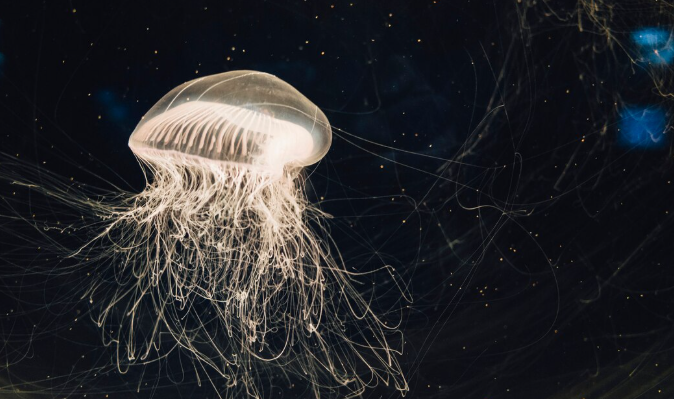
In June 2026, a team on board the Schmidt Ocean Institute’s research ship Falkor (also) has just completed a two-week expedition off the coast of Brazil, recovering 31 new species from the midwater, which is the dark, murky column of ocean between the seafloor and the sunlit surface. Nine jellyfish. There are seven siphonophores. There are seven comb jellies. Theoretically, a gossamer worm should be able to move faster than its body shape permits. The list appears to have been put together for dramatic effect, but it is completely authentic, verified by 3D laser imaging and genome sequencing carried out on the ship in a matter of days as opposed to the decades that such identification has traditionally taken.
The expedition’s chief scientist, Karen Osborn, a research zoologist at the Smithsonian, put it simply: scientists are still learning about the midwater, which is the planet’s largest habitat. That’s a big admission. There may be more undiscovered life in those dark, pressurized water columns than in any reef system or rainforest that people have spent centuries cataloging. As this develops, there’s a feeling that the 2007 Celebes expedition was a crack in the door rather than an end.
The methodology, rather than the quantity of species, is what makes the more recent discoveries noteworthy. Gelatinous organisms are shredded by conventional sampling nets. They arrive on deck devoid of context and color, like biological confetti. DeepPIV lasers, shadowgraph cameras, and open-source confocal microscopes developed at Stanford are among the tools currently in use that enable researchers to study a living organism in its natural habitat and map cellular structures while the animal is still in motion. The ocean never stops surprising people, according to Bigelow Laboratory’s John Burns. That seems both true and a little concerning.
The 2007 Atolla gigantea, a black jellyfish with a deep red pigmentation and bioluminescent prey concealed inside a gut meant to conceal light, symbolized a type of biological ingenuity that people on land seldom think about. Darkness as a disguise. Using invisibility as a hunting tactic. Researchers are still charting the evolution of these adaptations and their implications for comprehending life in environments devoid of sunlight, crushing pressure, and nearly no oxygen for navigation nearly two decades later.
It’s difficult to ignore the fact that the ocean consistently prevails in this specific dispute. Every time science seems to be getting close to a comprehensive understanding of marine life, something new literally emerges to remind everyone that the picture is still lacking. The signal was the black jellyfish. Another is the 31 species discovered this past spring. The vast, dark, and mostly unexplored midwater is still communicating. Scientists are becoming more adept at deciphering them.
