

Standing in, say, northern Wisconsin at eleven at night and watching green ribbons pulse across the sky has a subtle disorienting quality. Those who have never given geomagnetic storms much thought now find themselves murmuring. Phones emerge. Necks are a crane. Despite everyone’s best efforts, the internet is unable to fully capture this kind of moment.
This week, the aurora borealis pushed abnormally far south, well beyond its usual territory near the Canadian border, creating that scene across twenty U.S. states. The geomagnetic activity had been closely monitored by NOAA, and their records provided a wealth of information. At level 4, the aurora doesn’t just flicker close to the poles, according to the agency’s Kp index reading of 4, a planetary measurement that ranges from 0 to 9. It moves. It gets brighter. It moves with an almost deliberate quality.
Northern Minnesota, the Upper Peninsula of Michigan, northeastern Washington, northern Montana, the Dakotas, and portions of Maine were among the states with the best views because these areas typically have sufficiently dark skies. As usual, the most consistent sightings came from Alaska and Canada. However, this week felt a little different from your typical geomagnetic event because twenty states were involved at all. Although scientists are cautious not to exaggerate any one week’s display, it’s possible that we’re in a period of increased solar activity.
When you sit with them, the mechanics underlying all of this are truly bizarre. Ejected from the sun, charged particles travel about 93 million miles before colliding with nitrogen and oxygen atoms in Earth’s atmosphere. The molecules are excited by the collision, actually agitated, and they release light as a result. Usually green due to oxygen at lower altitudes. Purples and reds from above. It feels almost surreal to watch because the entire event takes place in almost complete silence.
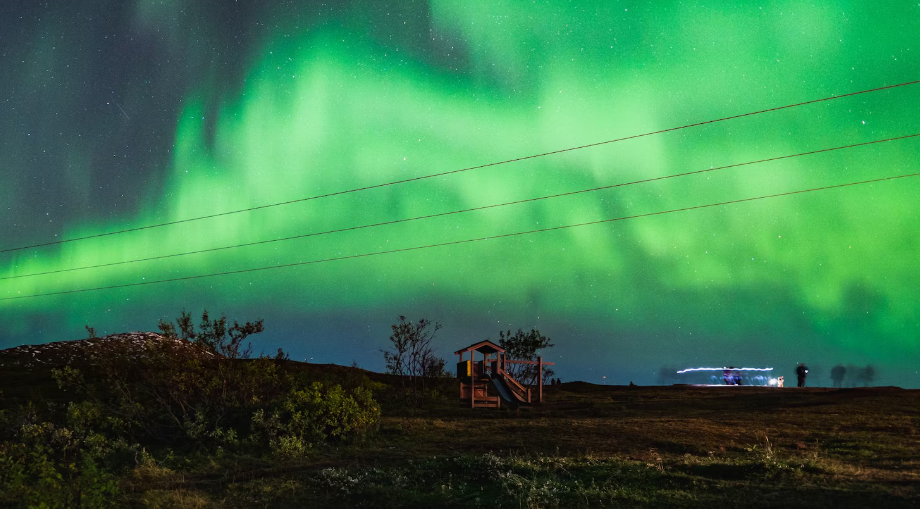
This week’s Kp-4 activity, according to NOAA, was slightly below the official G1 geomagnetic storm threshold, which calls for a Kp index of 5. Technically, that’s a significant distinction, but it probably didn’t matter to anyone standing in a dark field in the Dakotas. There was light, and it was in motion. According to NOAA’s regular recommendations, peak visibility usually occurs between 10 p.m. and 2 a.m., when geomagnetic activity reaches its nightly peak. The majority of this week’s best reports were submitted at midnight, which is consistent.
It’s important to note that people’s experiences of aurora events have actually changed as a result of smartphone cameras. Sometimes colors and structure that aren’t fully visible in real time are revealed by night mode, which draws in light that the human eye misses. Although it may seem like cheating, there’s a feeling that it enhances the experience—you take a picture and realize the sky was doing more than you thought. This week, a few photographers from northern Minnesota posted pictures of deep crimson bands that dominated the frame but hardly showed up.
For the majority of potential viewers, light pollution continues to be the largest barrier. Even a powerful aurora is washed out by cities. The sky opens up more as you move away from artificial light, serving as a reminder that some of the most amazing things still require some work to reach. It’s really unclear if this level of solar activity will persist in the upcoming weeks, but NOAA will continue to monitor. To be honest, the rest of us will as well.
